
If your vehicle has to be stopped in an emergency
Only in an emergency, such as if it becomes impossible to stop the vehicle in the normal way, stop the vehicle using the following procedure:
1. Steadily step on the brake pedal with both feet and firmly depress it.
Do not pump the brake pedal repeatedly as this will increase the effort required to slow the vehicle.
2. Shift the shift lever to N.
 If the shift lever is shifted to N
3. After slowing down, stop the vehicle in a safe place by the road.
4. Stop the engine.
 If the shift lever cannot be
shifted to N
3. Keep depressing the brake pedal with both feet to reduce vehicle
speed as much as possible.
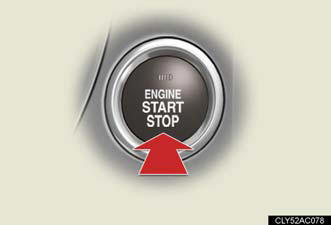
4. Stop the engine by pressing and holding the “ENGINE START STOP” switch for 3 consecutive seconds or more.
5. Stop the vehicle in a safe place by the road.
CAUTION:
If the engine has to be turned off while driving
- Power assist for the brakes and steering wheel will be lost, making the brake
pedal harder to depress and the steering wheel heavier to turn. Decelerate as
much as possible before turning off the engine.
See also:
If you have a flat tire
Remove the flat tire and replace it with the spare provided.
Before jacking up the vehicle
Stop the vehicle on a hard, flat surface.
- Set the parking brake.
- Shift the shift lever to P.
- Stop ...
Anti-glare inside rear view mirror
In AUTO mode, sensors are used to detect the headlights of vehicles
behind and automatically reduces the reflected light.
1. Turns AUTO mode ON/OFF
The indicator comes on when
AUTO mode is turne ...
Fifth Gear Lexus IS review
There is no tougher automotive segment in the world than the compact
executive class, which has long since been ruled over by the BMW 3 Series and
Audi A4. And the Lexus IS does run its German riv ...